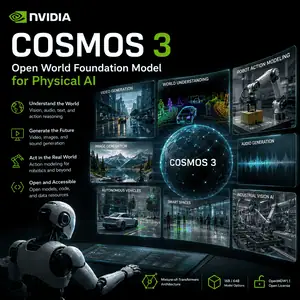
Cosmos 3 gives developers a new way to build and test physical AI systems. This article explains what Cosmos 3 is, how it works, and where teams can use it.
What Is Cosmos 3?
Cosmos 3 is an open world foundation model from NVIDIA.
It targets physical AI. That means robotics, autonomous vehicles, smart spaces, industrial cameras, and other systems that need to understand the real world.
NVIDIA describes Cosmos 3 as an omnimodal model. It can work across text, images, video, sound, and action data. It can reason about a scene, generate future states, and support robot action modeling.
Cosmos 3 is not a general chatbot. It is a foundation model family for world understanding, world simulation, synthetic data generation, and physical AI development.
Overview
| Item | Details |
|---|---|
| Name | Cosmos 3 |
| Developer | NVIDIA |
| Model type | Open world foundation model for physical AI |
| Main focus | Robotics, autonomous vehicles, smart spaces, industrial vision AI |
| Core architecture | Mixture-of-Transformers |
| Input types | Text, image, video, sound, action data |
| Output types | Text, image, video, sound, action data |
| Open source status | Open models and code resources are available |
| License | OpenMDW1.1 |
| Available model sizes | Cosmos3-Nano 16B, Cosmos3-Super 64B |
Features
Vision Reasoning
Cosmos 3 can analyze images and video to understand objects, motion, scene context, and likely outcomes.
A robotics team can use this to inspect what happens in a workspace before sending commands to a robot.
World Generation
Cosmos 3 can generate images, video, and sound from prompts or visual inputs.
This helps teams create training examples for scenes that cost too much to capture in the real world.
Action Modeling
Cosmos 3 can work with action data such as robot trajectories, joint positions, gripper states, and camera motion.
This matters for teams that train robots to move, grasp, place, and recover from unusual situations.
Mixture-of-Transformers Architecture
Cosmos 3 uses a Mixture-of-Transformers design.
One part handles reasoning. Another part handles multimodal generation. This lets the model interpret a scene before it generates video or action outputs.
Multiple Model Options
NVIDIA lists Cosmos3-Nano and Cosmos3-Super as available models.
Nano targets smaller and faster workflows. Super targets higher-end generation and reasoning tasks.
Use Cases
Robot Policy Training
A robotics engineer can use Cosmos 3 to generate action-conditioned data for manipulation tasks.
For example, a team training a warehouse robot can create task rollouts for moving items, handling bins, or reaching around obstacles.
Autonomous Vehicle Scenario Simulation
An AV team can use Cosmos 3 to create rare driving situations.
That can include unusual pedestrian movement, complex intersections, bad weather, or edge cases that appear too rarely in collected driving logs.
Smart City Video Understanding
A city operations team can use Cosmos 3 as part of a vision AI workflow.
The model can help analyze camera streams, reason about object movement, and add context to traffic or public-space events.
Industrial Safety Monitoring
A factory team can use Cosmos 3 to reason over moving equipment, workers, and paths.
This can help vision systems identify risky movement patterns before an operator only sees a simple detection alert.
Synthetic Video Data Generation
A computer vision team can use Cosmos 3 to generate video data for model training and evaluation.
This helps when real footage lacks enough examples of defects, collisions, unusual motion, or rare lighting conditions.
Physical AI Research
Researchers can use Cosmos 3 to test world models, robot action prediction, video generation, and physical reasoning.
The open release gives teams a starting point for experiments without training a full world model from scratch.
Limits To Know
Cosmos 3 still needs task-specific testing before real deployment.
A robot, vehicle, or safety system cannot rely on generated data alone. Teams need validation with real sensors, real operating conditions, and domain-specific safety checks.
Cosmos 3 also needs NVIDIA GPU infrastructure for practical development. Teams should check hardware, precision, and deployment requirements before planning production use.