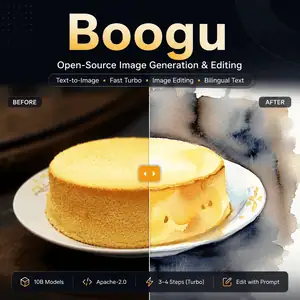
Boogu is a new open-source image model family for text-to-image generation and image editing. This guide explains what Boogu is, how it works, what variants exist, and when you may want to try it.
What Is Boogu?
Boogu usually refers to Boogu-Image-0.1, an open-source image generation and editing model family.
It is not a general chatbot. It is not a full design app by itself. It is a model family built for visual generation tasks, including text-to-image, image-to-image editing, fast generation, and bilingual text rendering.
The project provides model weights and inference code. Developers can run the models, test demos, or connect them to custom image workflows.
Overview
| Item | Details |
|---|---|
| Name | Boogu-Image-0.1 |
| Type | Image generation and editing model family |
| Main tasks | Text-to-image, image editing, image-to-image transformation |
| License | Apache-2.0 |
| Open source | Yes |
| Model size | 10B variants listed by the project |
| Main variants | Base, Turbo, fp8, Edit, Edit-Turbo |
| Official paid API | The project says it does not currently provide one |
| Third-party API | fal lists Boogu text-to-image access with usage-based pricing |
| Best for | Developers, AI artists, researchers, workflow builders |
Features
Text-to-Image Generation
Boogu can generate images from written prompts. The Base model focuses on high-quality generation, diversity, controllability, and harder text-heavy scenes.
Fast Turbo Variant
Boogu-Image-0.1-Turbo targets faster image generation. The project describes it as a distilled variant that can work in about 3 to 4 steps, which makes it useful for quicker iteration.
Image Editing
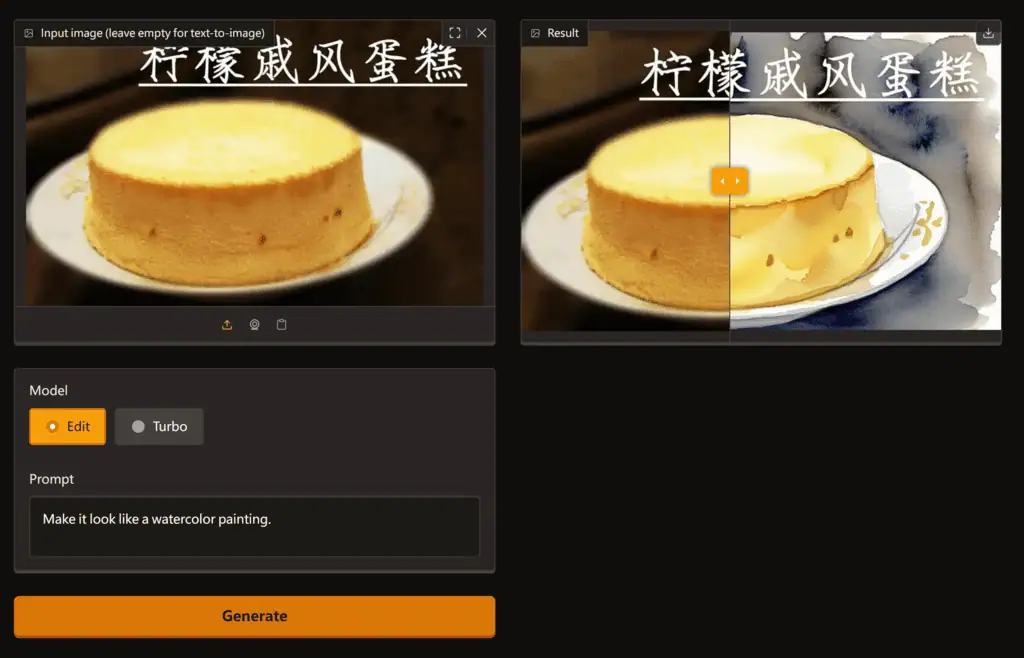
Boogu-Image-0.1-Edit supports image-to-image workflows. You can provide a reference image and use natural-language instructions to change the image.
This suits photography edits, style changes, object adjustments, and creative transformations. The project notes that large viewpoint or structure changes can still be limited.
Chinese and English Text Rendering
Boogu focuses on bilingual text rendering. This matters for posters, product mockups, UI concepts, documents, and visual designs that need readable Chinese or English text.
The Base model targets dense text scenarios. Turbo works better as a general default for photorealistic output.
fp8 Deployment Options
The fp8 variants reduce memory needs for deployment. Teams that care about serving cost, throughput, or constrained hardware may prefer these versions after testing quality tradeoffs.
Open Weights and Developer Access
Boogu offers model checkpoints and inference code through public model repositories. This makes it easier to inspect, test, fine-tune, or integrate into local workflows than a closed image API.