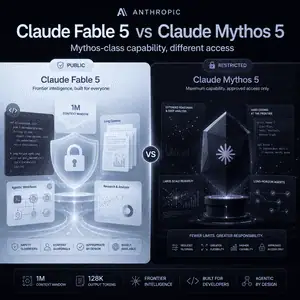
Claude Fable 5 and Claude Mythos 5 mark a new Claude model class from Anthropic.
They target hard coding, long-horizon agents, research-heavy analysis, and complex knowledge work. The catch is access. Fable 5 is the public version with safeguards. Mythos 5 keeps fewer limits and only approved users can access it.
What Is Claude Fable 5 and Mythos 5?
Claude Fable 5 and Claude Mythos 5 are Anthropic frontier AI models.
Fable 5 is the broadly available model. Anthropic positions it as its most capable widely released Claude model for demanding reasoning and long-running agentic work.
Mythos 5 uses the same capability level but removes certain safety classifiers. Anthropic limits Mythos 5 to approved customers through Project Glasswing.
You can think of Fable 5 as the “locked” public version of Mythos-class capability.
That lock matters. Fable 5 can refuse sensitive requests or route them to Claude Opus 4.8. Mythos 5 gives vetted partners more direct access for approved cybersecurity, infrastructure, and research work.
Overview
| Item | Claude Fable 5 | Claude Mythos 5 |
|---|---|---|
| Developer | Anthropic | Anthropic |
| Model type | Frontier Claude model | Frontier Claude model |
| Model class | Mythos-class capability | Mythos-class capability |
| Access | Broadly available | Limited access |
| API model ID | claude-fable-5 |
claude-mythos-5 |
| Main audience | Developers, enterprises, product teams | Approved security and research partners |
| Open source | No | No |
| Public weights | Not released | Not released |
| Context window | 1M tokens | 1M tokens |
| Max output | Up to 128k tokens | Up to 128k tokens |
| Input price | $10 per million tokens | $10 per million tokens |
| Output price | $50 per million tokens | $50 per million tokens |
| Safety classifiers | Yes | No, for approved access paths |
| Fallback behavior | Can retry or route to another Claude model | Not generally available |
| Data retention | 30 days | 30 days |
| Zero data retention | Not available | Not available |
| Availability | Claude API, AWS, Amazon Bedrock, Vertex AI, Microsoft Foundry | Project Glasswing and approved access |
Features
Mythos-Class Reasoning
Fable 5 brings Mythos-level capability to a wider audience.
Use it when a task needs planning, verification, tool use, and sustained reasoning across many steps.
Long-Horizon Agentic Work
Fable 5 can support agents that work through long coding or knowledge tasks.
This fits code migration, repository analysis, workflow automation, research agents, and multi-step business operations.
Large Context Window
Both models support a 1M token context window.
You can load large codebases, long documents, transcripts, contracts, research notes, or internal project history into a single workflow.
High Output Limit
Both models support up to 128k output tokens.
This helps when you need full reports, long implementation plans, structured research output, or multi-file code drafts.
Advanced Vision
Fable 5 can analyze charts, tables, diagrams, files, PDFs, and screenshots.
Teams can use it for document review, financial analysis, UI inspection, design-to-code workflows, and report analysis.
Safety Classifiers
Fable 5 includes safety classifiers for sensitive areas.
When a request triggers a classifier, the API can return a refusal or let you retry with another Claude model. Developers should design their apps to handle this path instead of treating it as a system error.
Fallback Support
Fable 5 supports fallback patterns.
Developers can retry refused requests on another Claude model through server-side fallback, client-side middleware, or manual retry logic.
Adaptive Thinking
Claude Fable 5 and Claude Mythos 5 use adaptive thinking.
Developers control thinking depth with the effort parameter. The API does not return raw chain-of-thought text.
Data Retention Requirements
Fable 5 and Mythos 5 require 30-day data retention.
They do not support zero data retention. Enterprise teams should review privacy, compliance, and procurement rules before sending sensitive production data.
Use Cases
Complex Code Migration for Engineering Teams
Engineering teams can use Fable 5 to inspect a large repository, plan a migration, edit code, and write tests.
A good workflow keeps a human reviewer in the loop for architecture decisions, security-sensitive code, and production merges.
AI Coding Agents for Developer Tools
Developer tool companies can use Fable 5 inside coding agents.
The model suits tasks that require file search, debugging, test writing, patch generation, and repeated revision.
Enterprise Research for Strategy Teams
Strategy and operations teams can use Fable 5 to review long documents and produce structured briefs.
The model can compare sources, extract key claims, organize evidence, and prepare drafts for human review.
Financial Document Analysis
Finance teams can use Fable 5 to work with reports, tables, charts, and PDFs.
Useful tasks include variance analysis, filing review, model commentary, risk summaries, and internal memo drafting.
Legal and Compliance Review
Legal teams can use Fable 5 to inspect contracts, compare clauses, and summarize obligations.
Lawyers should use it as a drafting and review assistant, not as a final legal authority.
Design and UI Review
Product and design teams can use vision features to compare screenshots, design files, and implementation output.
This helps engineers catch layout gaps, missing states, and mismatched UI behavior before review.
Defensive Cybersecurity for Approved Partners
Approved cybersecurity teams can use Mythos 5 through Project Glasswing.
The intended use is defensive work, such as vulnerability discovery, critical software review, patch support, and infrastructure protection.
Biomedical Research for Vetted Access Programs
Anthropic has discussed trusted access paths for biology and chemistry research.
Researchers should treat model output as a research aid. Lab validation, safety review, and domain expert oversight still decide what moves forward.
Fable 5 vs Mythos 5
Fable 5 and Mythos 5 share the same broad capability level.
The difference is access control.
Fable 5 is the model most developers can use. It includes safeguards that may refuse or reroute sensitive requests.
Mythos 5 is the restricted version for approved partners. It removes some safeguards for specific trusted-access use cases.
Use Fable 5 for commercial products, internal tools, coding workflows, research analysis, and enterprise automation.
Use Mythos 5 only if your organization has approved access and a clear security or research need.
What the “Lock” Means for Developers
Fable 5 is powerful, but it is not a drop-in replacement for every Claude model.
Your application should handle refusal responses. A refusal can arrive as a successful API response, not as a failed HTTP request.
Your application should also plan for fallback behavior. Some sensitive requests may need to run on another Claude model, such as Opus 4.8.
This affects product design. You need clear user messaging, logging, retry logic, and billing rules for fallback flows.
Pricing and Availability
Anthropic lists the same token pricing for both models.
| Token type | Price |
|---|---|
| Input | $10 per million tokens |
| Output | $50 per million tokens |
Fable 5 is available through the Claude API and major cloud platforms.
AWS supports Fable 5 through Amazon Bedrock and Claude Platform on AWS. AWS users may need to enable provider data sharing because Anthropic requires 30-day retention for this model class.
Mythos 5 is not generally available. Organizations need approved access through Project Glasswing or related trusted-access programs.
Should You Use Claude Fable 5?
Use Claude Fable 5 when the task is difficult enough to justify a premium model.
Good fits include large codebases, long documents, agentic workflows, document-heavy analysis, and high-value research work.
Use a smaller or cheaper Claude model for simple chat, short summaries, routine extraction, and high-volume tasks where frontier reasoning does not change the result.
Fable 5 gives more teams access to Mythos-class capability. Anthropic keeps the strongest access path locked behind trusted programs.