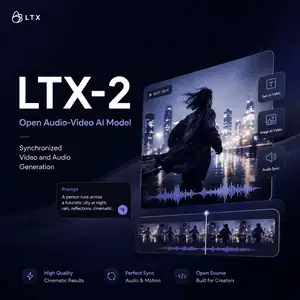
What Is LTX-2?
LTX-2 is an open-source audio-video foundation model developed by Lightricks.
It is designed to generate video and synchronized audio in a single model, making it useful for text-to-video, image-to-video, creative production, and AI video research.
Unlike many video models that focus only on silent clips, LTX-2 aims to create complete video outputs with motion, visuals, and sound working together.
Model Overview
| Item | Details |
|---|---|
| Model name | LTX-2 |
| Developer | Lightricks |
| Model type | Audio-video generation foundation model |
| Architecture | Diffusion Transformer / DiT-based model |
| Main inputs | Text prompts, images, video conditions, audio-driven prompts |
| Main outputs | Generated video with synchronized audio |
| Key capability | Joint video and audio generation in one model |
| Open-source access | Model weights and code are available |
| Local use | Supported through Hugging Face, GitHub, Diffusers, and ComfyUI workflows |
| API access | Available through LTX platform and providers |
| Best use cases | AI video generation, image-to-video, creative prototyping, research, production pipelines |
| Latest related version | LTX-2.3 |
| Pricing | Open weights are available; API and cloud usage depend on provider pricing |
Features
Native Audio and Video Generation
LTX-2 can generate synchronized video and audio together.
This makes it more useful for scenes that need sound effects, music, speech rhythm, or audio-led motion instead of silent video clips.
Text-to-Video Creation
Users can generate video from a written prompt.
This is useful for concept videos, cinematic shots, product visuals, social media clips, and fast creative testing.
Image-to-Video Workflow
LTX-2 supports image-guided generation, allowing users to turn a still image into a moving scene.
This is especially useful for product showcases, character animation, and visual storytelling.
Open Weights and Local Execution
LTX-2 provides open access to model weights and code.
Developers and researchers can run it locally, inspect the pipeline, build custom workflows, or integrate it into their own tools.
Multiple Performance Modes
The model family includes full, quantized, and distilled versions.
This gives users more flexibility between output quality, generation speed, and hardware requirements.
Production-Focused Control
LTX-2 is designed for more controlled creative workflows.
It supports use cases such as camera control, motion direction, style consistency, and LoRA-based customization.
ComfyUI and Diffusers Support
LTX-2 can be used through developer-friendly ecosystems such as ComfyUI and Diffusers.
This makes it easier to test the model without building a full video generation pipeline from scratch.
FAQ
Is LTX-2 open source?
Yes. LTX-2 provides open model weights and code, making it accessible for local use, research, customization, and experimentation.
Who developed LTX-2?
LTX-2 was developed by Lightricks, the company behind the LTX creative AI platform.
What can LTX-2 generate?
LTX-2 can generate AI video with synchronized audio.
It supports workflows such as text-to-video, image-to-video, audio-guided video, and production-style creative generation.
Does LTX-2 generate audio?
Yes. One of the main features of LTX-2 is native audio-video generation.
This means the model can create sound that matches the generated visual scene, instead of requiring a separate audio tool.
Can I run LTX-2 locally?
Yes. LTX-2 can be downloaded and used locally through the official GitHub and Hugging Face resources.
The exact hardware requirement depends on the model variant, resolution, frame rate, and inference setup.
Does LTX-2 work with ComfyUI?
Yes. LTX-2 supports ComfyUI workflows, which makes it easier for creators and developers to test video generation without writing all inference code manually.
What is the difference between LTX-2 and LTX-2.3?
LTX-2 is the main model family, while LTX-2.3 is a newer version with improved output quality, audio, prompt adherence, and workflow support.
If you are starting a new project, LTX-2.3 is usually the version worth checking first.
Is LTX-2 free?
The open model weights are available for users to access and run under the model license.
However, running the model still requires GPU hardware, cloud infrastructure, or paid API usage depending on how you deploy it.
Is LTX-2 good for production use?
LTX-2 is positioned as a production-grade AI video model.
It is especially relevant for developers, creative teams, and studios that need more control than a simple online video generator.
What are the limitations of LTX-2?
Like other AI video models, LTX-2 may still struggle with long-term consistency, precise motion, complex multi-character scenes, and exact visual details.
For professional use, results usually need prompt testing, editing, and sometimes post-production.