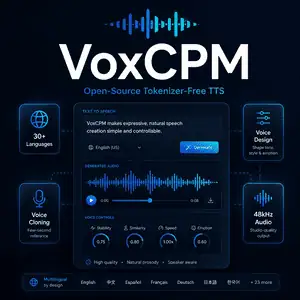
What Is VoxCPM?
VoxCPM is an open-source text-to-speech model family developed by OpenBMB.
It is designed for natural speech generation, multilingual TTS, voice design, and zero-shot voice cloning. The latest major release, VoxCPM2, uses a tokenizer-free diffusion autoregressive architecture to generate speech without relying on traditional discrete speech tokenizers.
Model Overview
| Item | Details |
|---|---|
| Model name | VoxCPM |
| Latest major version | VoxCPM2 |
| Developer | OpenBMB |
| Model type | Text-to-Speech, voice cloning, voice design |
| Architecture | Tokenizer-free diffusion autoregressive TTS |
| Backbone | MiniCPM-4 |
| Model size | 2B parameters for VoxCPM2 |
| Audio quality | 48kHz studio-quality output |
| Language support | 30 languages |
| Main features | Multilingual TTS, voice design, controllable voice cloning, streaming |
| Training data | Over 2 million hours of multilingual speech for VoxCPM2 |
| License | Apache-2.0 |
| Best use cases | AI voice apps, narration, localization, audiobook tools, game voices, character voices |
| Local deployment | Supported with Python package and Hugging Face model weights |
| Pricing | Free open-source weights; compute cost depends on local GPU or cloud provider |
Features
Tokenizer-Free Speech Generation
VoxCPM avoids the traditional pipeline of converting speech into discrete tokens.
Instead, it models speech in a continuous representation space, which helps preserve acoustic details such as tone, rhythm, emotion, and speaking style.
Multilingual Text-to-Speech
VoxCPM2 supports 30 languages, including English, Chinese, Japanese, Korean, Spanish, French, German, Arabic, Hindi, Russian, Vietnamese, and more.
Users can input text directly without adding a manual language tag.
Voice Design from Text
VoxCPM2 can generate a new voice from a natural-language description.
For example, users can describe gender, age, tone, pace, and emotion, then generate speech in that style without uploading reference audio.
Controllable Voice Cloning
VoxCPM can clone a voice from a short reference clip.
VoxCPM2 also supports style guidance, allowing users to adjust emotion, speed, and expression while preserving the speaker’s core timbre.
High-Fidelity 48kHz Output
VoxCPM2 outputs 48kHz audio using AudioVAE V2.
This makes it more suitable for production-style voice generation than basic TTS models with lower audio quality.
Context-Aware Prosody
VoxCPM can infer speaking style from the meaning of the text.
This helps it generate more natural rhythm, pauses, emphasis, and emotional expression instead of reading every sentence in a flat voice.
Real-Time Streaming
VoxCPM2 supports streaming generation and can reach low real-time factors on high-end GPUs.
This makes it useful for interactive voice agents, live narration, and low-latency speech applications.
Open-Source and Commercial-Ready
VoxCPM2 is released under the Apache-2.0 license.
Developers can use the model weights and code for research, product testing, and commercial projects, while still needing proper safety checks for voice cloning use cases.
FAQ
Is VoxCPM open source?
Yes. VoxCPM is open source, and VoxCPM2 is released under the Apache-2.0 license.
This allows developers to use, modify, and deploy the model, including in commercial projects.
What is VoxCPM used for?
VoxCPM is used for text-to-speech, multilingual speech generation, voice cloning, voice design, and expressive AI narration.
It is useful for voice assistants, audiobooks, games, localization, video dubbing, and character voice generation.
What is the difference between VoxCPM and VoxCPM2?
VoxCPM is the broader model family.
VoxCPM2 is the latest major release, with 2B parameters, 30-language support, 48kHz audio output, voice design, controllable voice cloning, and improved multilingual speech generation.
Does VoxCPM support voice cloning?
Yes. VoxCPM supports zero-shot voice cloning from a short reference audio clip.
VoxCPM2 also adds controllable cloning, so users can guide emotion, pace, and expression while keeping the speaker’s voice identity.
Can VoxCPM create a voice without reference audio?
Yes. VoxCPM2 supports voice design from text.
Users can describe the desired voice, such as “a calm middle-aged male narrator” or “a cheerful young female voice,” and generate speech in that style.
How many languages does VoxCPM2 support?
VoxCPM2 supports 30 languages.
The official list includes languages such as English, Chinese, Japanese, Korean, French, German, Spanish, Arabic, Hindi, Russian, Vietnamese, Thai, Turkish, Portuguese, and more.
Can I run VoxCPM locally?
Yes. VoxCPM can be used locally through the official Python package and Hugging Face model weights.
The exact hardware requirement depends on the model version, output length, streaming mode, and inference setup.
Is VoxCPM good for real-time voice apps?
VoxCPM2 supports streaming generation and is designed for low-latency use cases.
For real-time applications, performance depends heavily on GPU hardware and inference optimization.
Is VoxCPM free?
The model weights and code are available as open-source resources.
However, running VoxCPM still requires local GPU hardware, cloud GPU rental, or a third-party hosting service.
What are the risks of VoxCPM?
The main risk is misuse of voice cloning.
Developers should avoid impersonation, fraud, or deceptive use, and should clearly label AI-generated speech when needed.