What Is ESMFold2?
ESMFold2 is Biohub’s next-generation protein structure prediction model. It is the successor to ESMFold and is designed to predict high-resolution, all-atom 3D structures of biomolecular complexes directly from sequence.
In simple terms, ESMFold2 helps researchers move from a protein sequence to a predicted 3D structure. That matters because protein shape is closely tied to biological function, binding behavior, and downstream design work.
Unlike the older ESMFold, ESMFold2 is not only about quickly folding single protein sequences. Biohub positions it as a newer model for biomolecular complex structure prediction, with support for protein, DNA, and RNA sequence inputs through its Fold tool.
Is There an ESMFold2 Online Version?
Yes. There are already online ways to use ESMFold2.
The most direct official route is the Biohub Platform, where Biohub provides an ESMFold2 model page, a Fold web tool, API access, tutorials, and developer resources. The Fold tool uses ESMFold2-Fast and allows users to run structure prediction from the browser.
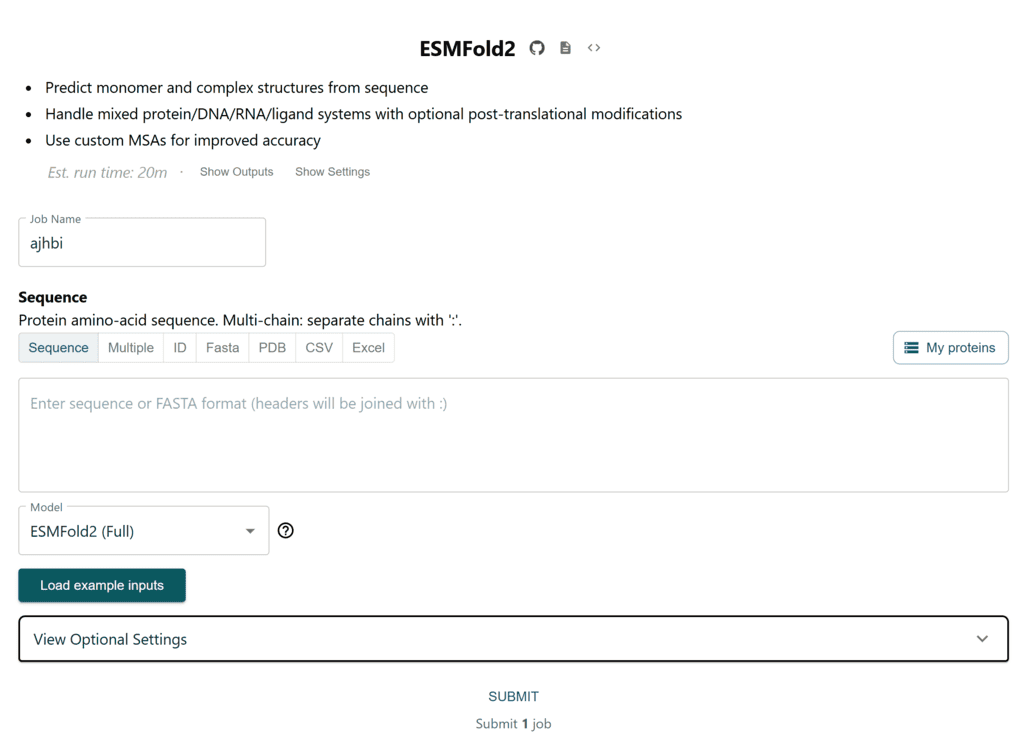
Tamarind Bio also provides an ESMFold2 online web server. Its ESMFold2 page describes a no-code web server for structure prediction and de novo protein design, with a workflow that starts by logging into Tamarind and using the ESMFold2 workspace.
So the best answer is: ESMFold2 is officially released by Biohub, and Tamarind Bio provides a cloud-based ESMFold2 interface for researchers who do not want to manage GPUs or deployment.
ESMFold2 Online Options
| Option | Best For | What You Get |
|---|---|---|
| Biohub Fold | Researchers who want the official web interface | Browser-based structure prediction powered by ESMFold2-Fast |
| Biohub API | Developers and research teams | Programmatic access through API keys and SDK workflows |
| Tamarind Bio | No-code biotech users | Web interface, API access, and workflow-style model execution |
| Hugging Face | ML developers | Model discovery and developer-facing model access |
| Modal example | Engineers building scalable workflows | Cloud deployment example for binder design |
Biohub is the best starting point if you want the official model source. Tamarind is more practical if you want a productized cloud workflow. Modal is more useful if your goal is engineering a scalable binder-design pipeline rather than simply testing one sequence.
How to Use ESMFold2 on Biohub
Biohub provides both a web tool and developer access.
The simplest path is:
- Open the Biohub Fold tool.
- Enter a protein sequence.
- Choose the ESMFold2-Fast model.
- Run Fold.
- Review and export the predicted structure.
For developers, Biohub also provides a quickstart flow: install the ESM Python package, create an API key, connect to the Biohub Platform API, and run inference through a client.
How to Use ESMFold2 on Tamarind Bio
Tamarind Bio positions its ESMFold2 page as a commercially available no-code web server. The workflow is built around logging into Tamarind, navigating to the ESMFold2 workspace, defining a design objective, choosing a format, allocating compute, running prediction or design scans, and exporting results.
This is useful for users who care more about running experiments than setting up infrastructure. Tamarind also exposes API documentation with endpoints for submitting jobs, submitting batches, listing jobs, downloading results, uploading files, and managing files.
That makes Tamarind a better fit for teams that want a hosted workflow, queue management, and API-based automation.
ESMFold2 vs ESMFold
ESMFold2 should not be treated as just a renamed ESMFold.
ESMFold was known for fast protein structure prediction from sequence. ESMFold2 is described by Biohub as the successor to ESMFold and is designed for high-resolution, all-atom structures of biomolecular complexes. It also supports optional MSA input for improved accuracy on challenging targets.
The practical difference is this:
ESMFold is better understood as a fast structure prediction model for protein sequences.
ESMFold2 is better understood as a newer structure prediction and design engine connected to the broader ESMC family, with stronger positioning around protein interactions, antibody-antigen prediction, and binder design.
Can ESMFold2 Be Used for Binder Design?
Yes, but this is a more advanced use case.
Biohub says researchers used ESMFold2 to design protein binders against cancer and immunology targets, with computational search completed far faster than traditional discovery timelines.
Modal also provides an engineering example for designing protein binders at scale with ESMFold2 and ESMC. The workflow folds candidate binders with a target protein, scores the predicted structure, updates the candidate sequence, and repeats the process.
For most users, this means ESMFold2 is not only a “predict my protein structure” model. It is also part of a larger protein design workflow.
Should You Use Biohub, Tamarind, or Local Deployment?
Use Biohub if you want the official model platform and the most direct route to ESMFold2.
Use Tamarind Bio if you want a no-code cloud interface, hosted job management, and API-based execution without building infrastructure yourself.
Use Hugging Face or local deployment if you are an ML developer and want more control over the model environment.
Use Modal if you want to build scalable cloud workflows around binder design or batch inference.
For a single sequence test, the online Biohub Fold tool is probably enough. For repeated research workflows, Tamarind or API access is more realistic. For product development or large-scale experimentation, you should expect to deal with cloud GPU cost, batching, result storage, and safety review.
ESMFold2 Limitations
ESMFold2 is powerful, but its output is still a prediction.
The model can help predict static structures, but it should not be treated as a full replacement for experimental validation. Protein dynamics, conformational flexibility, multiple biological states, and real-world lab behavior may require additional methods and wet-lab confirmation.
That limitation matters. A predicted structure can help prioritize experiments, generate hypotheses, or support early-stage design work. It should not be treated as final biological proof.
Who Is ESMFold2 For?
ESMFold2 is mainly useful for:
- Computational biologists
- Protein engineers
- Drug discovery researchers
- Antibody and binder design teams
- BioML developers
- Students learning protein structure prediction
It is less useful for casual AI users. If you do not work with protein sequences, biomolecular structures, or biological design workflows, ESMFold2 is probably not the right tool to start with.
FAQ
Is ESMFold2 free?
Biohub describes ESMC, ESMFold2, and ESM Atlas as freely available to the global scientific community, but practical usage may still depend on account access, credits, rate limits, or platform-specific policies.
Is Tamarind Bio the official ESMFold2 website?
No. Biohub is the model publisher and official platform. Tamarind Bio is a cloud platform that provides hosted access to ESMFold2 through a no-code web interface and API workflow.
Does ESMFold2 support DNA and RNA?
Biohub’s Fold tool says it can predict 3D structures of biomolecular complexes directly from protein, DNA, and RNA sequences.
What is ESMFold2-Fast?
ESMFold2-Fast is the faster model variant shown in Biohub’s Fold tool. It is likely the better starting point for users who want browser-based prediction without setting up their own infrastructure.
Is ESMFold2 better than AlphaFold?
It depends on the task. ESMFold2 appears especially relevant for protein-protein interactions, antibody-antigen prediction, and binder design workflows. But “better” depends on the target, input quality, MSA availability, compute budget, and validation workflow.
Bottom Line
ESMFold2 is not just another protein folding model. It is Biohub’s newer structure prediction and protein design engine, built around the ESMC model family.
If you want to try ESMFold2 online, start with Biohub Fold. If you need a hosted no-code workflow or API-based job management, Tamarind Bio is a practical cloud option. If you are building research infrastructure, look at Biohub’s API, Hugging Face model listings, and cloud deployment examples.
For serious biological work, treat ESMFold2 as a way to accelerate research decisions, not as a replacement for experimental validation.